Losing one or more teeth can affect far more than the appearance of your smile. Missing teeth may make it harder to chew certain foods, speak clearly, and feel confident in social or professional situations. Depending on the location and number of missing teeth, tooth loss may also affect the way the remaining teeth fit together.
Fortunately, modern dentistry offers several effective ways to replace missing teeth. Two of the most common solutions are dental implants and dentures. Both can restore your smile and improve oral function, but they differ significantly in how they are designed, placed, maintained, and experienced by the patient.
Dental implants are secured within the jaw and used to support replacement teeth. Dentures are removable appliances that replace several missing teeth or an entire arch of teeth. Some patients may also benefit from implant-supported dentures, which combine aspects of both options.
The right treatment depends on your oral health, jawbone condition, number of missing teeth, lifestyle, budget, and personal preferences. There is no single answer that works for everyone.
At Pascack Dental Arts in Montvale, NJ, we help patients throughout Bergen County and Pascack Valley understand their tooth replacement options. Our dental team performs a detailed examination, listens to your concerns, and develops a personalized treatment plan designed to restore comfort, function, and confidence.
Why Replacing Missing Teeth Is Important
Some patients believe that replacing a missing tooth is primarily a cosmetic decision. While restoring your smile can certainly improve your confidence, tooth replacement can also support your ability to eat and speak.
The effects of missing teeth may include:
- Difficulty chewing certain foods
- Changes in speech or pronunciation
- Reduced confidence when smiling
- Movement of neighboring teeth
- Changes in the way your upper and lower teeth meet
- Increased stress on the remaining teeth
- Changes in facial appearance
- Reduced dietary variety
- Jawbone changes around the missing tooth
- Irritation from chewing on only one side of the mouth
A missing front tooth may create an obvious cosmetic concern, while a missing back tooth may be less visible. However, back teeth play an important role in grinding and chewing food. Even when a space is hidden, replacing the missing tooth may help restore more balanced oral function.
The American Dental Association identifies dental implants and dentures as established options for replacing missing teeth. Implants are designed to function similarly to natural teeth, while dentures can replace several teeth or an entire dental arch. American Dental Association
What Are Dental Implants?
A dental implant is a small post that is surgically placed into the jawbone. It functions as an artificial tooth root and provides support for a dental restoration.
After the implant is placed, the surrounding bone gradually heals around it through a process called osseointegration. Once the implant is stable, the dentist can attach the components needed to complete the replacement tooth.
A dental implant restoration typically consists of three parts:
- The implant post: The portion placed within the jawbone
- The abutment: The connector between the implant and restoration
- The restoration: The visible crown, bridge, or denture supported by the implant
Dental implants can be used in several ways. A single implant can replace one missing tooth. Multiple implants can support a dental bridge, and strategically positioned implants may stabilize a full arch of replacement teeth.
The American Dental Association describes implants as posts made from materials compatible with the body that are placed in the jaw to provide stable support for replacement teeth. American Dental Association
What Are Dentures?
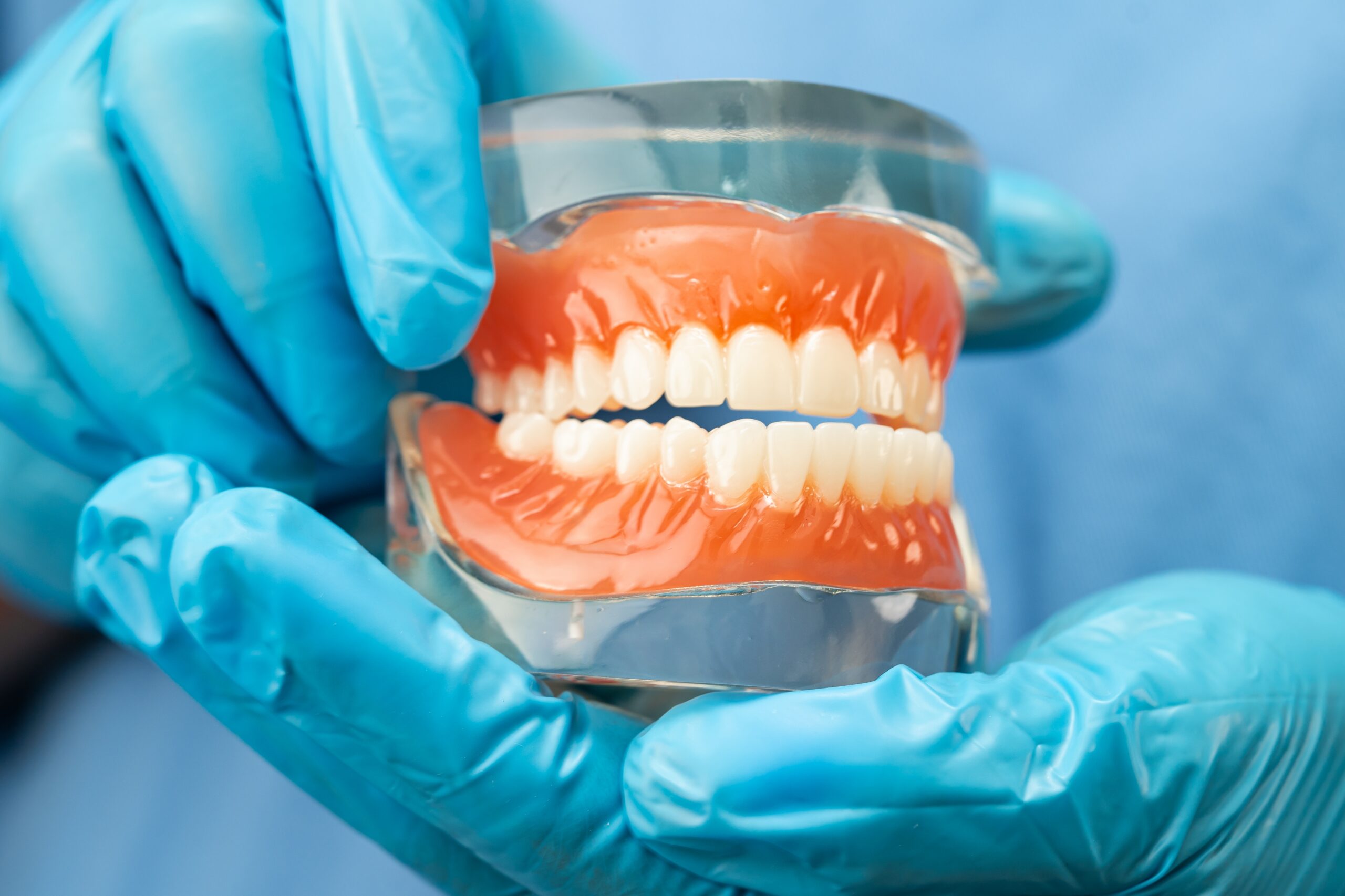
Dentures are removable dental appliances that replace missing teeth and some of the surrounding tissue. They are custom-made to fit the shape of the patient’s mouth.
Depending on how many teeth are missing, a patient may receive complete or partial dentures.
Complete Dentures
Complete dentures replace all the teeth in the upper jaw, lower jaw, or both. They rest on the gums and are generally removed for cleaning and while sleeping.
Partial Dentures
Partial dentures replace several missing teeth when healthy natural teeth remain. The appliance usually includes replacement teeth attached to a gum-colored base. It may use clasps or other attachments to help hold it in position.
Immediate Dentures
Immediate dentures are created before the remaining teeth are removed and inserted shortly after extraction. This can prevent the patient from going without visible teeth during the initial healing period.
Because the gums and jaw can change shape during healing, immediate dentures may require relining, adjustment, or replacement after the tissues stabilize.
Implant-Supported Dentures
Implant-supported dentures connect to implants placed in the jaw. Depending on the design, they may be removable by the patient or fixed in place and removable only by a dental professional.
This option can provide greater stability than conventional dentures, particularly in the lower jaw.
The American Dental Association notes that dentures can help patients eat and speak more effectively than they could without teeth. Dentures can also support the face and improve the appearance of the smile. American Dental Association
Dental Implants vs. Dentures: The Main Differences
Dental implants and dentures can both replace missing teeth, but the patient experience is different. Comparing the most important factors can help you prepare for a consultation with your dentist.
Stability and Security
One of the most significant differences is how each restoration stays in place.
Dental implants are anchored within the jawbone. This gives the replacement teeth a stable foundation and can make them feel more like natural teeth during speaking and chewing.
Traditional dentures rest on the gums. Upper dentures may be helped by suction, while lower dentures can be more difficult to stabilize because of the tongue and shape of the lower jaw. Dental adhesive may improve retention for some patients, but it does not correct an appliance that no longer fits properly.
Implant-supported dentures offer a middle ground. They remain attached to implants during use, which can improve stability while replacing an entire arch of teeth.
Appearance
Both implants and dentures can be designed to produce an attractive, natural-looking smile.
An implant-supported crown emerges from the gum area in a way that can closely resemble a natural tooth. The crown is customized for shape, size, and color.
Modern dentures are also created to complement the patient’s face, smile, and remaining teeth. The replacement teeth and gum-colored base can be carefully selected to create a natural appearance.
The final cosmetic result depends on several factors, including treatment planning, the condition of the gums and bone, the materials used, and the skill involved in designing the restoration.
Comfort
Because implants are anchored in the jaw, they do not rest on the gums in the same way as conventional dentures. Many patients appreciate the secure feeling of an implant-supported restoration.
Dentures may initially feel bulky or unfamiliar. Patients often need time to adjust to speaking and chewing while the muscles of the mouth learn to help control the appliance.
New dentures may also cause temporary sore spots. Follow-up visits allow the dentist to evaluate the fit and make necessary adjustments.
A denture that becomes uncomfortable should be examined rather than ignored. The shape of the gums and jaw can change over time, affecting the fit of the appliance.
Chewing and Food Choices
Replacing missing teeth can improve chewing, but the amount of improvement varies by treatment.
Implants generally provide a strong and stable foundation. Depending on the restoration and the patient’s oral health, many people can enjoy a varied diet after healing.
Traditional dentures can also restore chewing ability, but some patients may need to modify how they eat. Cutting food into smaller pieces, chewing on both sides, and avoiding extremely sticky or hard foods may make eating more comfortable.
Implant-supported dentures may offer improved chewing stability compared with conventional removable dentures.
Regardless of the option selected, patients should follow their dentist’s instructions during the adjustment and healing periods.
Effect on the Jawbone
Natural tooth roots stimulate the surrounding jawbone during biting and chewing. When a tooth is lost, the bone in that area no longer receives the same stimulation and may gradually change.
Because an implant is placed within the jawbone, it can help maintain stimulation in the treated area. This is one of the reasons dental implants are often considered for long-term tooth replacement.
Traditional dentures rest on top of the gums and do not replace natural tooth roots. Changes in the jawbone and gums may continue over time, which can affect how the denture fits.
This does not mean every patient should automatically receive implants. Jawbone condition is only one factor in the treatment decision.
Treatment Time
Dental implants typically require a longer treatment process than conventional dentures.
The implant process may involve:
- Initial examination and imaging
- Treatment of active dental problems
- Tooth extraction, if needed
- Bone grafting, if needed
- Implant placement
- Healing and osseointegration
- Abutment placement
- Creation and placement of the final restoration
Healing times vary. Some patients may need several months before the final restoration is attached. Other patients may qualify for a different schedule based on their oral health and treatment plan.
Dentures can often be completed more quickly. Immediate dentures may be available at the time teeth are removed, while conventional dentures are usually made after the mouth has healed sufficiently.
Faster treatment does not necessarily mean better treatment. The best schedule is the one that safely supports your long-term oral health and restorative goals.
Maintenance and Daily Care
Dental implants require consistent oral hygiene. Although the implant itself cannot develop a cavity, plaque and bacteria can accumulate around the restoration and gumline.
Patients with dental implants should:
- Brush thoroughly every day
- Clean between the implant and neighboring teeth
- Use floss, interdental brushes, or other recommended tools
- Attend regular dental examinations
- Receive professional cleanings
- Avoid smoking and other habits that may affect oral health
- Report bleeding, swelling, discomfort, or looseness promptly
Dentures also require daily care. Patients should:
- Remove and rinse the appliance after eating when practical
- Brush the denture using an appropriate denture cleanser
- Clean the gums, tongue, and any remaining natural teeth
- Handle the denture carefully
- Store it as instructed when not in use
- Avoid using hot water that could alter its shape
- Attend regular dental visits
- Have the fit evaluated if discomfort develops
Regular professional care is important for both options. Plaque can collect around natural teeth, implants, crowns, and dentures. Consistent cleaning helps protect the gums and remaining oral structures. National Institute of Dental and Craniofacial Research
Durability and Longevity
Dental implants are designed as a long-term tooth replacement option. However, no dentist should promise that an implant or its restoration will last forever.
The lifespan of implant treatment depends on:
- Daily oral hygiene
- Gum health
- Bone health
- Smoking or tobacco use
- Teeth grinding or clenching
- Medical conditions
- Regular dental care
- The location of the implant
- The amount of force placed on the restoration
The implant post and visible restoration are separate components. Even if the implant remains stable, the crown, bridge, or denture attached to it may eventually require repair or replacement.
Dentures also have a limited functional lifespan. Normal wear and changes in the mouth may eventually require relining, rebasing, adjustment, repair, or replacement.
A denture that feels loose or causes repeated soreness should be evaluated. Continuing to use a poorly fitting denture can make eating difficult and irritate oral tissues.
Cost and Financial Considerations
Dental implants generally have a higher initial cost than conventional dentures. The total investment depends on the number of missing teeth, number of implants, type of restoration, need for extractions, need for bone grafting, and complexity of the case.
Dentures usually require a lower initial investment, making them more accessible for patients who need to replace many teeth. However, patients should also consider potential future expenses associated with relines, repairs, adjustments, and replacements.
The lowest initial price is not always the lowest long-term cost. At the same time, the most expensive option is not automatically the right option.
A useful financial comparison should include:
- Initial treatment cost
- Diagnostic imaging
- Extractions
- Bone grafting
- Temporary teeth
- Final restoration
- Follow-up care
- Repairs and adjustments
- Expected future replacement needs
- Insurance benefits
- Financing options
Pascack Dental Arts accepts most major dental insurance plans and offers flexible options for patients without insurance. Payment plans and interest-free financing may also be available for qualifying patients. Coverage and eligibility should be confirmed before treatment.
Advantages of Dental Implants
Dental implants may offer several benefits for appropriate candidates:
- A stable foundation for replacement teeth
- An appearance that closely resembles natural teeth
- Improved chewing ability
- No need to remove the restoration for routine daily use in many cases
- Replacement of one tooth without using adjacent teeth for support
- Support for bridges or full-arch restorations
- Stimulation of the jawbone in the treatment area
- Easier speech compared with an unstable denture
- Long-term restorative potential
These benefits can make implants an appealing solution, but they must be weighed against the need for surgery, healing time, cost, and individual health factors.
Potential Disadvantages of Dental Implants
Dental implants may not be right for every patient. Considerations include:
- A higher initial investment
- The need for oral surgery
- A longer treatment timeline
- Possible bone grafting
- Healing requirements
- Risk of complications
- The need for excellent oral hygiene
- Ongoing professional maintenance
- Medical or anatomical factors that may affect candidacy
Implant treatment can encounter problems such as infection, failure to integrate with the bone, gum inflammation, restoration damage, or complications involving nearby structures.
A careful evaluation helps identify risk factors and determine whether implant treatment is appropriate.
Advantages of Dentures
Dentures continue to be an important and effective tooth replacement option. Potential advantages include:
- Replacement of many or all missing teeth
- Lower initial cost than implant treatment
- No implant surgery for conventional dentures
- A generally shorter treatment timeline
- Improved smile appearance
- Support for lips and facial tissues
- Improved ability to speak and chew compared with having no teeth
- Easy removal for cleaning
- Availability for patients with significant bone loss
- The option of immediate placement after extractions in certain cases
Dentures can be particularly helpful for patients who want a non-surgical solution or who are not candidates for dental implants.
Potential Disadvantages of Dentures
Traditional removable dentures may involve certain limitations:
- Movement during speaking or eating
- A learning period
- Reduced chewing efficiency compared with stable implant restorations
- Gum irritation or sore spots
- The need for dental adhesive in some cases
- Changes in fit as the gums and jaw change
- Periodic relines and adjustments
- Removal for cleaning and sleeping
- Dietary modifications
- The possibility of clicking or shifting if the fit is poor
Many of these issues can be managed through proper design, careful adjustment, and regular dental care.
Who May Be a Good Candidate for Dental Implants?
Dental implant candidates generally need sufficient oral and overall health to undergo surgery and support healing.
Your dentist may evaluate:
- The health of your gums
- The quantity and quality of available jawbone
- Your medical history
- Medications
- Tobacco use
- Oral hygiene habits
- Teeth grinding
- The location of missing teeth
- The condition of remaining teeth
- Your ability to attend follow-up visits
- Your treatment expectations
Insufficient bone does not always rule out implants. Bone grafting may help rebuild certain areas before or during implant placement. However, grafting adds time, cost, and another step to treatment.
Patients with gum disease usually need to address active infection before implant placement. Gum health is critical because the tissue surrounding an implant helps protect and support it.
Certain medical conditions or medications may affect healing. Your dentist should review your complete health history and may communicate with your physician when appropriate.
Who May Be a Good Candidate for Dentures?
Dentures may be appropriate for patients who:
- Have lost all or most of their teeth
- Need to replace several teeth in different areas
- Prefer a removable solution
- Want to avoid implant surgery
- Have medical factors that make surgery less suitable
- Have insufficient bone for implants and do not want grafting
- Need a more affordable initial treatment
- Want teeth available soon after extractions
- Are willing to adapt to a removable appliance
- Can maintain the appliance and attend adjustment visits
A denture should still be carefully planned and customized. Choosing dentures does not mean accepting an uncomfortable or unnatural-looking result.
What Are Implant-Supported Dentures?
Patients do not always have to choose between completely fixed implants and completely unsupported dentures. Implant-supported dentures combine implant stability with the ability to replace an entire arch of teeth.
Several implants are placed in the jaw to support the denture. The specific number and location depend on the patient’s anatomy and restoration design.
Potential benefits include:
- Greater stability
- Less movement during meals
- Improved confidence when speaking
- Reduced reliance on adhesive
- Better distribution of chewing forces
- Increased comfort for some patients
- Easier removal for cleaning with certain designs
Some implant-supported dentures snap onto attachments and can be removed by the patient. Other full-arch restorations remain fixed and are removed only by a dental professional.
The dentist must evaluate your bone, gums, bite, smile, and cleaning ability before recommending a design.
Can You Switch From Dentures to Dental Implants?
Some patients begin with dentures and later consider implants because they want greater stability.
Switching may be possible, but candidacy depends on the condition of the jawbone, gums, remaining teeth, and general health. Bone loss can progress during years of denture use, so grafting may be needed before implants can be placed.
In some situations, an existing denture can be modified temporarily. In other cases, a completely new restoration must be created.
If your dentures move, cause discomfort, or limit what you can eat, schedule an evaluation. The solution may involve an adjustment, reline, replacement denture, denture adhesive guidance, or implant-supported treatment.
What Happens During a Tooth Replacement Consultation?
A comprehensive consultation is essential because online comparisons cannot determine which treatment is safest or most appropriate for your mouth.
During your visit, the dentist may:
- Review your dental concerns and goals
- Discuss your medical and dental history
- Examine your remaining teeth and gums
- Evaluate your bite
- Assess the areas of missing teeth
- Take digital X-rays or other necessary images
- Evaluate available jawbone
- Look for gum disease or infection
- Discuss implant, denture, and alternative options
- Explain the expected timeline
- Review maintenance requirements
- Provide a personalized treatment estimate
Be open about your priorities. Some patients are most concerned about stability. Others care most about avoiding surgery, completing treatment quickly, maintaining a certain budget, or achieving a particular cosmetic result.
Understanding your priorities helps the dentist recommend a treatment plan that fits your life.
Questions to Ask Your Dentist
Before deciding between dental implants and dentures, ask:
- Am I a candidate for dental implants?
- Do I have sufficient jawbone?
- Will I need bone grafting?
- Do I have active gum disease?
- How many teeth need to be replaced?
- Would a partial denture work for me?
- Could implant-supported dentures be appropriate?
- How long will treatment take?
- Will I have temporary teeth during healing?
- What will I be able to eat?
- How will I clean the restoration?
- What future maintenance should I expect?
- What does my dental insurance cover?
- Are financing options available?
- What are the risks and alternatives?
Your dentist should explain both the advantages and limitations of each option without pressuring you.
How to Care for Your New Smile
Whichever option you choose, long-term success depends partly on daily care and regular dental visits.
Caring for Dental Implants
Brush the restoration and gumline at least twice daily using the technique recommended by your dental team. Clean between teeth and beneath implant-supported bridges using floss, interdental brushes, or another recommended device.
Attend professional cleanings and examinations so the dentist can monitor the implant, gums, bite, and restoration.
If you grind or clench your teeth, a custom nightguard may help protect the restoration. Avoid chewing ice and using your teeth to open packages.
Caring for Dentures
Remove and clean dentures daily. Use products intended for denture care because some regular toothpastes can be too abrasive.
Clean your gums, tongue, palate, and remaining teeth. If your dentist recommends removing the appliance overnight, store it as directed to prevent drying or distortion.
Never attempt to repair or reshape a denture yourself. Household glue and do-it-yourself adjustment can damage the appliance or injure your mouth.
Dental Implants or Dentures: How Do You Decide?
Dental implants may be attractive if you want strong stability, natural-feeling function, and a fixed restoration. You must also be willing to undergo surgery, allow time for healing, maintain excellent oral hygiene, and make a larger initial investment.
Dentures may be a better fit if you want to replace many teeth without implant surgery, need a shorter treatment process, or prefer a lower initial cost. You should be prepared for a period of adjustment and the possibility of future relines or replacement.
Implant-supported dentures may be considered when you need to replace a full arch but want more security than conventional dentures provide.
The best choice is not determined by age alone. It is based on oral health, bone support, medical history, functional needs, financial considerations, and personal preferences.
Why Choose Pascack Dental Arts?
Pascack Dental Arts has provided comprehensive dental care to Montvale and surrounding communities since 1989. Our experienced dental team offers preventive, restorative, cosmetic, implant, periodontal, endodontic, orthodontic, pediatric, and emergency dental services in one convenient location.
Patients choose our practice because we provide:
- Personalized tooth replacement consultations
- Dental implant treatment
- Full and partial dentures
- Implant-supported restorative options
- Bone grafting when appropriate
- Periodontal care
- Dental crowns and bridges
- Oral surgery
- Advanced dental technology
- A comfortable and welcoming environment
- Flexible financial options
- A 24-hour emergency phone service
- Care in English, Spanish, and Russian
We understand that tooth loss can affect your health, comfort, appearance, and confidence. Before recommending treatment, we listen to your concerns and explain your options clearly. Our goal is to help you make an informed decision that addresses your dental needs, lifestyle, and budget.
Frequently Asked Questions About Dental Implants and Dentures
1. Are dental implants better than dentures?
Dental implants are not automatically better for every patient. They generally provide greater stability and function more like natural teeth, but they require surgery, adequate healing, consistent oral hygiene, and a larger initial investment. Dentures may be more appropriate for patients who prefer a removable, non-surgical, or more affordable option. Your dentist can evaluate which treatment best fits your health and goals.
2. Can dentures look like natural teeth?
Yes. Modern dentures are customized according to the patient’s facial features, gum appearance, tooth color, and smile. Careful design can produce an attractive and natural-looking result. The fit and appearance should be evaluated during follow-up visits.
3. How long does the dental implant process take?
The timeline varies according to the number of implants, bone condition, need for extractions or grafting, and healing response. Some cases take several months because the implant must integrate with the jawbone before the final restoration is placed. Your dentist will provide an estimated schedule after completing an examination.
4. Can I get dental implants if I already wear dentures?
Possibly. Many denture wearers can be evaluated for conventional implants or implant-supported dentures. The dentist will assess your jawbone, gums, medical history, and existing appliance. Bone grafting or a new denture may be required.
5. Do dental implants and dentures require regular dental visits?
Yes. Dental visits remain important even if you no longer have natural teeth. The dentist examines the gums, oral tissues, bite, implants, restorations, and fit of the denture. Professional care can identify inflammation, damage, or fit problems before they become more serious.
Schedule a Tooth Replacement Consultation in Montvale, NJ
You do not have to allow missing teeth to limit your diet, confidence, or quality of life. Dental implants, traditional dentures, partial dentures, and implant-supported restorations can all provide valuable benefits when selected and designed for the right patient.
The first step is a comprehensive dental evaluation.
Contact Pascack Dental Arts to discuss dental implants and dentures in Montvale, Bergen County, and the Pascack Valley area. Our team will evaluate your oral health, answer your questions, and explain the treatment options that may help restore your smile.
Pascack Dental Arts
21 South Kinderkamack Road
Montvale, NJ 07645
Phone: (201) 391-5565
Email: info@pascackdental.com
Website: pascackdental.com